
Important IEC Standards for Electrical Design: A Complete Guide for MEP Consultants and Electrical Engineers
Author: Sudhir Sharma
R.S. Consultants | Consulting Engineers for MEP Services
Introduction
Electrical system design is one of the most critical components of modern building infrastructure. Whether it is a residential development, commercial complex, hospital, industrial facility or high-rise building, a properly engineered electrical system is essential for safety, reliability, operational efficiency and long-term performance.
The International Electrotechnical Commission (IEC) publishes internationally recognised technical standards covering electrical installations, power distribution, protection systems, electrical equipment, testing and commissioning.
For electrical consultants, MEP engineers, architects and developers, knowledge of these standards helps in selecting appropriate equipment, carrying out engineering calculations, preparing technical specifications and ensuring coordinated electrical system design.
In this article, we explore the important IEC standards that every electrical design professional should understand, together with their practical applications in building and infrastructure projects.
1. IEC Standards for Low-Voltage Electrical Installations
The IEC 60364 series is one of the most important references for low-voltage electrical installation design.
It provides requirements for electrical installation planning, protection, cable selection, earthing and verification.
| IEC Standard | Application in Electrical Design |
|---|---|
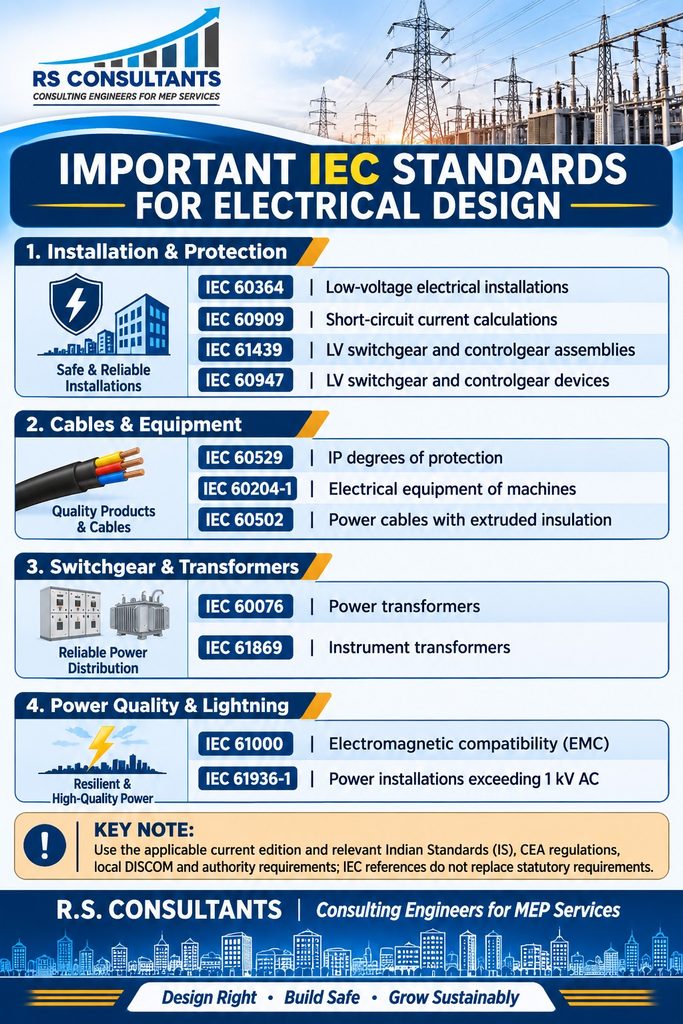
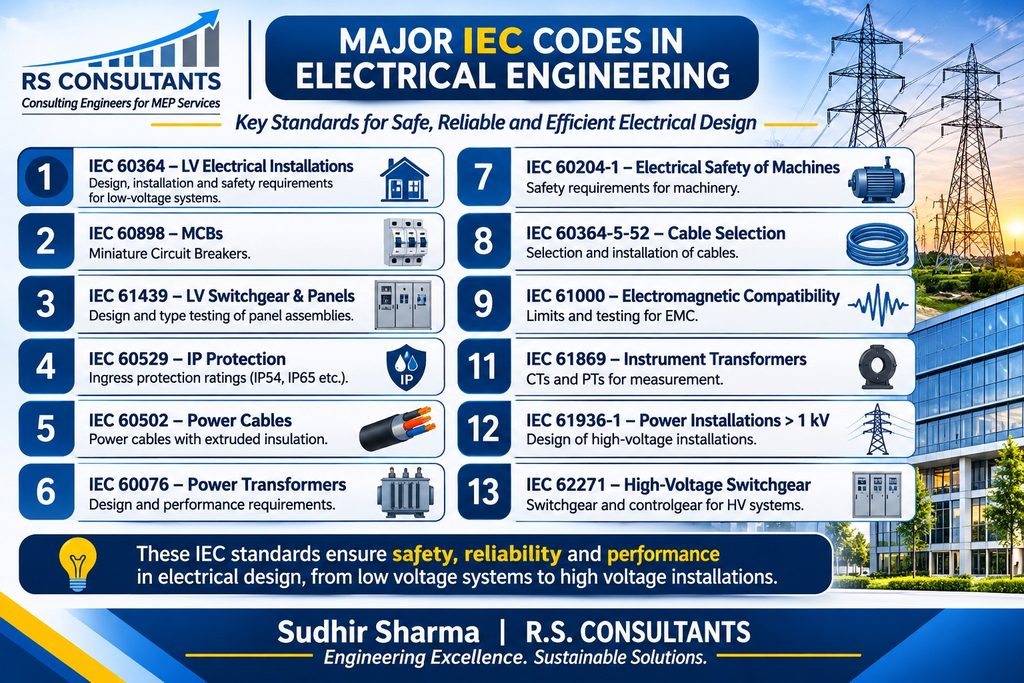
| IEC 60364 | Low-voltage electrical installations |
| IEC 60364-4-41 | Protection against electric shock |
| IEC 60364-4-42 | Protection against thermal effects |
| IEC 60364-4-43 | Overcurrent protection |
| IEC 60364-4-44 | Voltage and electromagnetic disturbances |
| IEC 60364-5-52 | Cable selection and wiring systems |
| IEC 60364-5-53 | Selection and erection of switching and control devices |
| IEC 60364-5-54 | Earthing arrangements and protective conductors |
| IEC 60364-6 | Inspection, testing and verification |
Practical application in MEP projects:
- Electrical load distribution and installation planning.
- Cable sizing and voltage-drop calculations.
- Protection against electric shock and electrical faults.
- Earthing and bonding design.
- Inspection and testing of electrical installations.
Official reference: IEC 60364-1:2025 – Fundamental Principles
2. Short-Circuit Calculation and Electrical Protection
Short-circuit calculations are essential for determining the fault level of an electrical distribution network and selecting suitable electrical equipment.
| IEC Standard | Application |
|---|---|
| IEC 60909 | Short-circuit current calculations |
| IEC 60947 | Low-voltage switchgear and controlgear |
| IEC 61439 | Low-voltage switchgear and controlgear assemblies |
| IEC 60255 | Measuring relays and protection equipment |
Practical application:
- Calculate maximum and minimum short-circuit currents.
- Determine the breaking capacity of ACBs and MCCBs.
- Verify the short-circuit withstand capacity of LT panels.
- Carry out protection coordination and discrimination studies.
- Select suitable protective devices for transformers, feeders and distribution boards.
Engineering consideration: A circuit breaker’s rated breaking capacity, the panel assembly’s short-circuit withstand capability and the protective device’s coordination must be assessed separately.
Official references:
- IEC 60909 – Short-Circuit Current Calculations
- IEC 61439-2 – Power Switchgear Assemblies
- IEC 60947 – LV Switchgear Series
3. Transformer and HT Electrical System Standards
Transformers and high-voltage distribution systems form the backbone of electrical infrastructure in large residential, commercial and industrial developments.
The following IEC standards are particularly relevant.
| IEC Standard | Application |
|---|---|
| IEC 60076 | Power transformers |
| IEC 61936-1 | Electrical installations exceeding 1 kV AC |
| IEC 62271 | High-voltage switchgear and controlgear |
| IEC 61869 | Instrument transformers (CTs and VTs) |
| IEC 60255 | Protection relays |
| IEC 60099 | Surge arresters |
Practical application in building projects:
- Transformer capacity and specification.
- HT switchgear selection.
- CT and PT selection for metering and protection.
- Relay protection and fault isolation.
- Substation design and equipment coordination.
- Electrical clearances and earthing arrangements.
For group housing, commercial buildings and industrial developments, these standards are useful references for designing transformer substations and HT distribution systems.
Official references:
- IEC Webstore – Transformer and Power Equipment Standards
- IEC 61936-1:2021 – High-Voltage Installations
- IEC 62271 – High-Voltage Switchgear Series
4. Power Cable and Electrical Equipment Standards
Cable selection is a critical engineering activity because incorrect cable sizing can result in excessive voltage drop, overheating, insulation failure and unnecessary energy losses.
| IEC Standard | Application |
|---|---|
| IEC 60502 | Power cables with extruded insulation |
| IEC 60228 | Conductors of insulated cables |
| IEC 60332 | Fire performance of cables |
| IEC 60754 | Halogen acid gas emission from cables |
| IEC 61034 | Smoke density of cables |
| IEC 60840 | HV cable systems and accessories |
| IEC 62040 | Uninterruptible Power Supply (UPS) systems |
Practical application:
- LT and HT cable selection.
- Cable ampacity and installation considerations.
- Voltage-drop calculations.
- Cable insulation and construction specifications.
- Fire performance requirements.
- UPS system selection and specification.
For building projects, cable design should also consider installation methods, ambient temperature, grouping, harmonic loading, short-circuit withstand and applicable derating factors.
Official reference: IEC 60502 Series – Power Cables
5. Lightning Protection and Surge Protection Standards
Lightning and transient overvoltages can damage electrical equipment, communication systems, building services and sensitive electronic installations.
The following standards are important for designing suitable protection systems.
| IEC Standard | Application |
|---|---|
| IEC 62305 | Protection against lightning |
| IEC 61643 | Surge protective devices |
| IEC 60364-4-44 | Protection against voltage disturbances |
Practical application:
- Lightning risk assessment.
- External lightning protection systems.
- Air termination and down conductor arrangements.
- Earth termination systems.
- Surge Protection Device (SPD) selection.
- Coordination of Type 1, Type 2 and Type 3 SPDs, as applicable.
For high-rise buildings, hospitals, data centres and commercial developments, lightning and surge protection should be coordinated with the overall electrical and earthing design.
Official references:
6. Specialised Electrical Installation Standards
Modern building infrastructure includes specialised electrical systems that require additional design considerations.
| IEC Standard | Application |
|---|---|
| IEC 60364-7-710 | Electrical installations in medical locations |
| IEC 60364-7-712 | Solar photovoltaic installations |
| IEC 60364-7-722 | Electric vehicle charging installations |
| IEC 60598 | Lighting equipment and luminaires |
| IEC 61347 | Lamp controlgear |
| IEC 62040 | UPS systems |
These standards are particularly relevant to hospitals, EV charging infrastructure, rooftop solar installations, commercial lighting and critical power systems.
Official reference: IEC 60364-7-710:2021 – Medical Locations
7. Top 10 IEC Standards Every MEP Consultant Should Prioritise
For professionals involved in electrical consultancy and MEP design, the following standards are a useful starting point.
| Priority | IEC Standard | Main Design Application |
|---|---|---|
| 1 | IEC 60364 | Complete LV installation design |
| 2 | IEC 60909 | Short-circuit calculations |
| 3 | IEC 61439 | LT panel design and verification |
| 4 | IEC 60947 | Circuit breakers and switchgear |
| 5 | IEC 60529 | IP protection classification |
| 6 | IEC 60076 | Transformer design and selection |
| 7 | IEC 62305 | Lightning protection |
| 8 | IEC 60502 | Power cable selection |
| 9 | IEC 61936-1 | HT electrical installations |
| 10 | IEC 61000 | Power quality and harmonics |
The actual standards required for a project depend on its voltage level, building occupancy, equipment, operating conditions and applicable statutory requirements.
8. Application of IEC Standards in Indian Electrical Projects
In India, IEC standards should be considered alongside the applicable Indian Standards, statutory regulations and building requirements.
Important Indian references include:
A. National Building Code of India 2016 (NBC)
Part 8 – Building Services, Section 2: Electrical and Allied Installations.
This section addresses electrical installation planning, distribution, wiring, safety, lightning protection and related building services.
Official reference: BIS – National Building Code of India 2016
B. Central Electricity Authority (CEA) Regulations
The Central Electricity Authority (Measures relating to Safety and Electric Supply) Regulations, 2023 establish important electrical safety requirements.
The applicable amendments and current regulatory provisions should also be checked before finalising a project.
Official references:
C. Bureau of Indian Standards (BIS)
Applicable IS standards and their amendments should be reviewed for electrical equipment, installations, cables, switchgear, transformers and other electrical systems.
Official reference: Bureau of Indian Standards
Important: IEC standards do not automatically replace Indian statutory requirements. The applicable BIS adoption, CEA regulations, NBC provisions, local electrical inspector requirements and DISCOM conditions must be considered for each project.
9. Important Updates to Check Before Using IEC Standards
IEC publications are periodically revised. Engineers should avoid relying on outdated editions when preparing project specifications.
Some important recent publications to note include:
- IEC 60364-1:2025 – Updated fundamental principles for low-voltage installations.
- IEC 60364-7-712:2025 – Revised requirements for solar PV installations.
- IEC 60909-0:2026 – Updated short-circuit calculation requirements.
- IEC 62305 series – Updated lightning protection publications.
- IEC 60947 series – Recent revisions across low-voltage switchgear standards.
The official IEC catalogue should always be consulted for publication status, amendments, corrigenda and the latest available editions.
Official reference: IEC Webstore – Standards Catalogue
10. Electrical Design Checklist for MEP Consultants
Before finalising an electrical design, consultants should review the following engineering activities:
- Connected load and maximum demand calculation.
- Transformer capacity and substation planning.
- HT and LT distribution system design.
- Cable sizing and voltage-drop calculations.
- Short-circuit current calculations.
- ACB, MCCB and protective device selection.
- Protection coordination and discrimination studies.
- LT panel design verification.
- Earthing and bonding design.
- Lightning protection and SPD coordination.
- Power factor correction and harmonic assessment.
- Emergency power and UPS requirements.
- Electrical drawings, specifications and BOQ.
- Inspection, testing and commissioning.
A coordinated approach to these activities helps improve electrical safety, system reliability, energy performance and maintainability.
Conclusion
Electrical engineering standards are the foundation of safe and reliable electrical infrastructure.
From low-voltage distribution and transformer selection to cable sizing, short-circuit calculations, protection coordination and lightning protection, IEC standards provide valuable technical guidance for electrical design professionals.
However, effective engineering is not achieved simply by referring to standard numbers. It requires understanding the technical requirements, applying the correct provisions and coordinating all electrical systems with the overall building design.
At R.S. Consultants, we believe that good engineering begins with technical knowledge, responsible design and a commitment to safety and quality.
Our objective is to support the development of reliable, efficient and sustainable infrastructure through integrated MEP consultancy and engineering solutions.
R.S. CONSULTANTS
Consulting Engineers for MEP Services
Sudhir Sharma
Engineering Excellence. Sustainable Solutions.
Website: https://rsconsultants.net.in
Contact: 9311103900
Official Technical References and Websites
- IEC International Standards: https://webstore.iec.ch/
- Bureau of Indian Standards: https://www.bis.gov.in/
- Central Electricity Authority: https://cea.nic.in/
- National Building Code of India: https://www.bis.gov.in/standards/national-building-code/
Technical disclaimer: This article is an engineering reference guide, not a substitute for the complete IEC publications, applicable Indian Standards, statutory approvals or project-specific engineering calculations. Always verify the current edition and scope of each standard before applying it to a project.
Article reviewed: 12 November 2026.

Leave a Reply